Picasso Brush
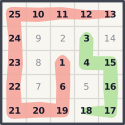
A stroke is only as long as one end number divided by the other, so covering the paper is a hunt for factors.
- Grades
- 2–6
- Subjects
- Multiplying & Dividing
- Kind
- Puzzle
- Cost
- Free, no account, no ads
- Original
- Picasso’s Canvas at MathPickle
What it is
The canvas is numbered, and a brushstroke runs from one square to another. Its length is not yours to choose: it is the bigger of the two end numbers divided by the smaller. A stroke may never double back alongside its own paint, and the goal is to leave as few bare squares as you can.
What it gives you to practise
Division asked the useful way round. Nobody hands you 12 ÷ 4 and waits; you are looking at a canvas and asking which pairs of numbers divide cleanly enough to reach where you need to get to. Factors become something you hunt for rather than something you recite. And like Mondrian, it does not end — there is only a barer canvas than the one before it.
In a classroom
Gordon Hamilton, MathPickle, 2018. It pairs well with Mondrian Puzzle in one lesson: two boards that refuse to finish, one scored by a subtraction and the other by a division.
The rules
Cover the numbered canvas with brushstrokes.
A stroke is as long as its bigger end ÷ smaller end.
A stroke never runs back alongside its own paint.
Leave as few bare squares as you can.
Drag from square to square, and let go to finish a stroke. Tap a stroke to wipe it.
Puzzles by Gordon Hamilton, MathPickle (2018).
Near it on the shelf
- Fractured FractionsOne point cuts the whole picture at once, and every piece has to come out holding the fraction written on it.
- GalaxeaTwo of the three dice are the sides of a rectangle — and the game is which two, and where to hang it.
- Mondrian PuzzleEvery rectangle painted is a multiplication, and the score is the gap between the biggest one and the smallest.