Fractured Fractions
One point cuts the whole picture at once, and every piece has to come out holding the fraction written on it.
- Grades
- 3–5
- Subjects
- Fractions, Multiplying & Dividing, Shapes & Space
- Kind
- Puzzle
- Cost
- Free, no account, no ads
- Original
- Fractured Fractions at MathPickle
What it is
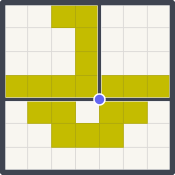
A pixel picture sits on a grid, and a single dot on it cuts the whole picture into two, three or four rectangles at once. Drag the dot and they all move together, one growing as another shrinks, each showing how much of itself is coloured as a fraction like 7/21. The cards in the tray say what the finished pieces have to hold.
What it gives you to practise
Equivalent fractions, with no way round them. A rectangle reads 10/15 and the card says 2/3. Another reads 30/72 and the card says 5/12. Simplifying is not an exercise bolted onto the puzzle; it is the only way to find where the dot goes. The harder packs never show a rectangle already wearing its card in lowest terms, and two cards that look nothing alike — 14/28 and 28/56 — can turn out to be the same half.
In a classroom
Gordon Hamilton, MathPickle, 2015; the four-way Split the Picture boards are ours. The early packs are a gentle way into simplifying. The last one is genuinely hard and does not reward guessing, which is the point of it.
The rules
A pixel picture is hiding on the grid. Fracture it into rectangles!
The goal
- Cover the whole picture with rectangles — every square inside exactly one rectangle, white squares too.
- Every rectangle wears a fraction card, and a card belongs on a rectangle whose colored squares make exactly that fraction of all its squares.
- Fractions in disguise count: a rectangle with 8 colored squares out of 16 is 8/16, which is 1/2 — the 1/2 card belongs on it.
The dot
- On most pictures every cut in the answer runs wall to wall from one point, so that is how the board opens: a dot on the picture, with two, three or four rectangles hanging off it.
- Drag the dot. All the rectangles move together — one grows as another shrinks — and each one keeps showing how much of it is colored, like 7/21.
- Find the place where the rectangles make the fractions on your cards, then drag each card onto its rectangle. A placed card can be dragged to another rectangle, or off the picture to go back to the tray.
- When the dot is in the right place and every card is on the right rectangle, the board turns green by itself. Nothing to press — then press Done to go on.
- Clear takes the cards off and puts the dot down somewhere else, so a fresh start really is fresh.
More than one part
- Most cards ask for one part in so many — 1/2, 1/3, 1/4. The More Than One Part boards ask for more than one: 2/3 means two parts in every three, so most of the rectangle is colored and only a little of it is not.
- No rectangle on those boards ever shows you its card. One reading 10/15 is the 2/3 card; one reading 8/10 is the 4/5 card. Simplify what you see, then go looking.
Split the Picture
- These pictures split into four at once, and they are the hardest kind: not one rectangle ever shows you its card.
- A card saying 5/12 sits on a rectangle reading 30/72. Halve it and you get 15/36; divide by three and you get 5/12. Simplifying is the only way to find the place.
- Two cards that look the same need not sit on rectangles that look anything alike: 14/28 and 28/56 are both 1/2.
Pictures with no dot
- The big pictures have answers that no single point can draw, so there you cut by hand.
- Drag on the grid to stretch a rectangle. While you stretch, it shows its count.
- Tap a rectangle to remove it — its card hops back to the tray. Rectangles may not overlap.
- Press Done when the picture is covered and every rectangle wears its card. It checks rectangle by rectangle, and if you are right it turns green — press it again to go on.
Colored pictures
- Some pictures use several colors. Then each card shows a color swatch: count only squares of that color — the rest are just scenery.
- Cards without a swatch on a colorful picture are wild: any single color may make the fraction.
Puzzles by Gordon Hamilton, MathPickle (2015). The Split the Picture boards are ours.