Blockopolis
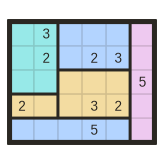
Every zone of the city is as many squares as its primes multiply to, so cutting it up is multiplying and factorising at once.
Play Blockopolis Share or embed
- Grades
- 3–6
- Subjects
- Multiplying & Dividing, Shapes & Space, Logic
- Kind
- Puzzle
What it is
A city of squares, some of them printed with a prime: a 2, a 3, a 5, a 7 or an 11. Cut the whole city into rectangular zones, every square in exactly one. Each zone must hold at least one number and have an area equal to the product of the numbers it holds: a zone holding a 2 and a 3 is six squares, a zone holding only a 7 is seven squares in a row, and a single square is never a zone. A zone is drawn by dragging from one corner to the opposite one, and a tap takes it away. Every city has exactly one answer. A right city is accepted as soon as it is checked; otherwise any square left uncovered is marked first, and then each zone is read in turn with its product written on it, 2×3=6, or 2×2≠6 in red. The cities grow from Village, 20 to 44 squares, through Town and City to Blockopolis, up to 117 squares with the numbers set out in patterns, and Special Districts, four cities with one idea each.
The rules
What it gives you to practise
Every zone is a multiplication read two ways: its sides, rows times columns, and its numbers, 2 × 2 × 3. Twelve squares can stand as 1 × 12, 2 × 6, 3 × 4, 4 × 3, 6 × 2 or 12 × 1, so deciding which one fits the city is factorising. Because every printed number is prime, a number alone in its zone makes a strip: a 5 on its own is five squares in a row or in a column, and nothing else. The way in is the square that only one zone can cover, often a corner or a number hemmed in by others; each zone laid takes room from its neighbours, and the next certain zone appears. On the small cities that carries the whole board. On the big ones the reasoning gets longer: a zone that holds the right numbers and is the right size can still be wrong, because it would leave a square that nothing can cover.
In a classroom
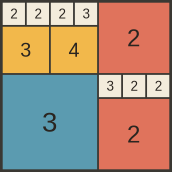
The rule fits in a sentence and works on squared paper with a pencil, so the first cities can be done on the board as a class: ask where a 7 can go, and why a 2 and a 3 together cannot be a 2 × 2. Pairs can then race a Village city, one reading the numbers out and one drawing, and compare where they started. The Special Districts are good for a discussion: one city holds only 2s, and another has four numbers and only one zone. Printed, a board is the empty city with its numbers, ready for a pencil.
 Diversity City
 Fractured Fractions
 Galaxea