Mondrian Puzzle
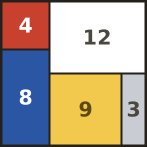
Every rectangle painted is a multiplication, and the score is the gap between the biggest one and the smallest.
- Grades
- 2–6
- Subjects
- Shapes & Space, Multiplying & Dividing, Adding & Subtracting
- Kind
- Puzzle
- Cost
- Free, no account, no ads
- Original
- Mondrian Art Puzzles at MathPickle
What it is
Cover the whole canvas with rectangles, no two of them the same shape — a 2×3 and a 3×2 count as the same shape, so only one of them may appear. Each rectangle says how many squares it covers, and your score is the biggest minus the smallest. Lower is better. There is no way to finish except by finding something better than your last answer.
What it gives you to practise
Every rectangle dragged out is a multiplication you have to do to know what you have made, and the score is a subtraction between two of them. The optimisation is the real content: there is no target to hit, only a number to push down, so a board stays open as long as somebody is still interested in it. For the larger canvases nobody knows the best possible score. That is not a puzzle withholding its answer key; it is an unsolved problem.
In a classroom
Gordon Hamilton designed it for exactly this — one board in front of a whole class, everybody pushing the same number down. Every legal answer found on the device is kept on a wall beside the board, sorted by score, so attempts accumulate instead of vanishing when somebody else has a go.
The rules
Cover the whole canvas with rectangles, no two of them the same.
Drag corner to corner. A rectangle says how many squares it covers.
A 2×3 and a 3×2 are the same shape — you may use only one of them.
Score = biggest − smallest. Lower is better.
Tap a rectangle to take it off again.
Near it on the shelf
- GalaxeaTwo of the three dice are the sides of a rectangle — and the game is which two, and where to hang it.
- Balanced ZebraBoth colours have to multiply out to the same number, and then to the largest that shape allows.
- Fractured FractionsOne point cuts the whole picture at once, and every piece has to come out holding the fraction written on it.