Kajitsu
Cutting fruit into pieces of a given size and symmetry: every morsel has to fold or spin onto itself.
- Grades
- 3–6
- Subjects
- Shapes & Space, Logic
- Kind
- Puzzle
- Cost
- Free, no account, no ads
- Original
- Kajitsu at MathPickle
What it is
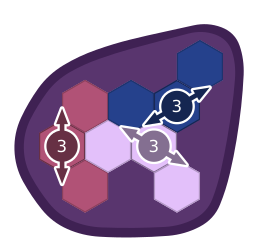
Kajitsu is Japanese for fruit. Each fruit is a patch of hexagons with pips on it, and every pip owns one morsel. The number on a pip says how many hexagons its morsel takes. The mark beside it says what symmetry that morsel must have: a double arrow to fold across a line, curved arrows to turn onto itself, as many times round as there are arrows.
What it gives you to practise
Symmetry as a property you have to build rather than recognise. A shape that folds across a line is a different demand from a shape that turns onto itself three times, and on a hexagonal grid neither one sits where intuition trained on squares expects. The cut also has to tile: every hexagon belongs to exactly one morsel, so a beautiful piece that strands its neighbour is no good.
In a classroom
The board prints. There is a print stylesheet that erases the answers, hides the screen controls and turns the coloured fruit into line art a pencil can reproduce, so the same board can go round a table on paper.
The rules
Kajitsu is Japanese for fruit. Cut each one into morsels — one for every pip.
Tap a pip, then drag: the number on it says how many hexagons its morsel takes.
A double arrow means the morsel folds across the dashed line, so a hexagon and its mirror are both in it.
Curved arrows turn the morsel onto itself instead — as many times round as there are arrows.
Near it on the shelf
- ZebraHerds multiply together, so three threes beat one nine — and a stone left on its own throws itself away.
- Balanced ZebraBoth colours have to multiply out to the same number, and then to the largest that shape allows.
- Fractured FractionsOne point cuts the whole picture at once, and every piece has to come out holding the fraction written on it.