Hitome's Paddocks
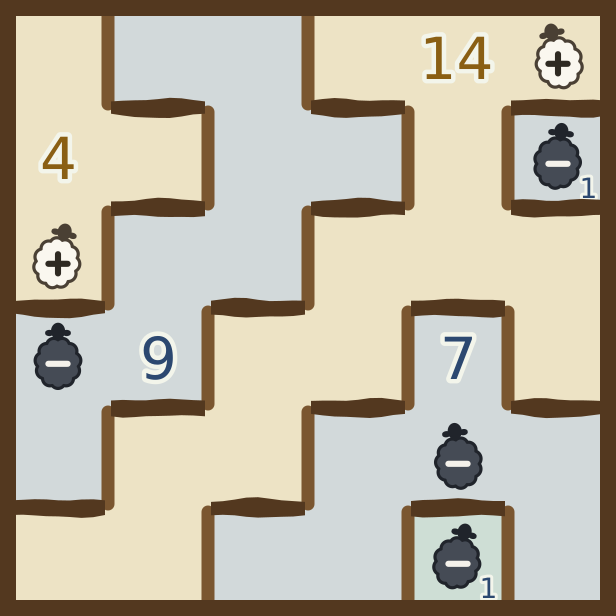
A sheep is worth the squares in its own field, and the two flocks have to end up worth the same.
- Grades
- 2–6
- Subjects
- Adding & Subtracting, Shapes & Space, Logic
- Kind
- Puzzle
- Cost
- Free, no account, no ads
What it is
The pasture next door to Hitome’s Garden, with a sum to settle. Every line between the squares must carry a fence one of two ways. The fences cut the grass into fields, and every sheep wants a field of its own: never two sheep in one field, never a field with no sheep in it. A sheep is worth the number of squares in its field, and the two flocks have to come out level — half the pasture each.
What it gives you to practise
Two demands at once, pulling against each other. One sheep to a field is what makes the board deducible: you can reason out which line has to be fenced which way. The balancing sum is what keeps the areas load-bearing, so a fencing that satisfies the first rule is usually wrong by the second. Counting squares, totalling them and comparing two totals is the arithmetic; deciding where the fence goes is the puzzle.
In a classroom
The early boards hand over some of the fences already cut — the dark, hand-drawn ones belong to the pasture and cannot be moved. That is a good place to stop and ask a class what those givens have already ruled out, before anybody draws anything.
The rules
Fence the pasture so that every sheep has a field of its own — and the two flocks end up grazing the same amount of grass.
Every line between the squares can carry a fence, and a fence stands on every other square. So a line has only two ways to go — and every line must be fenced one way or the other. On the early boards some fences are up before you arrive: the dark, hand-cut ones are the pasture's own, and nothing you do will move them.
The fences cut the pasture into fields. Every sheep wants a field to itself: never two sheep in one field, and never a field with no sheep in it.
A sheep is worth the number of squares in its field. The white sheep count up, the black sheep count down, and the whole flock has to come to nothing at all — which is the same as saying each flock grazes exactly half the pasture.
Near it on the shelf
- GalaxeaTwo of the three dice are the sides of a rectangle — and the game is which two, and where to hang it.
- Mondrian PuzzleEvery rectangle painted is a multiplication, and the score is the gap between the biggest one and the smallest.
- Finding ZeroEvery number turned over says how far zero is, so the hunt closes in by reasoning rather than guessing.