Hitome's Garden
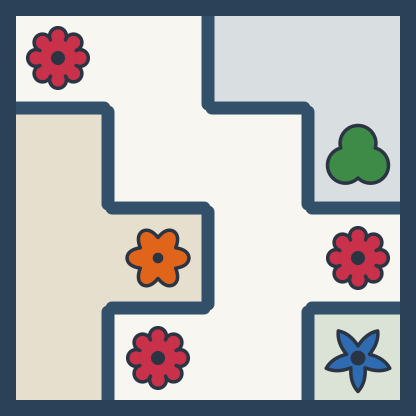
Every line has just two ways to go, and the walls they make decide which flowers end up sharing a bed.
- Grades
- 2–6
- Subjects
- Logic, Shapes & Space
- Kind
- Puzzle
- Cost
- Free, no account, no ads
What it is
Hitomezashi is a Japanese running stitch — over, under, over, under. Here every line of the cloth is sewn that way, and each line has only two ways to start. The stitches that show become walls, the walls cut the cloth into beds, and every bed has to end up holding flowers of exactly one kind.
What it gives you to practise
Each line is a single choice between two options, and the finished picture is the consequence of all those choices together — which is what makes the board reasonable rather than searchable. The sunflower is the solitary one and needs a bed to itself; every other kind gathers, so all the tulips share one bed and all the poppies share another. Working out which line must start which way, and being able to say why, is the whole puzzle.
In a classroom
Gordon Hamilton, MathPickle. Hitomezashi is worth five minutes on its own before the puzzle: the same over-under rule on squared paper draws the same patterns by hand, with nothing to solve.
The rules
Sew flowers in their beds.
Each line sews in an on-off pattern.
The visible part helps make the edges of a bed.
Every bed needs a flower, but only one kind of flower.
Near it on the shelf
- Hitome's PaddocksA sheep is worth the squares in its own field, and the two flocks have to end up worth the same.
- KajitsuCutting fruit into pieces of a given size and symmetry: every morsel has to fold or spin onto itself.
- Balanced ZebraBoth colours have to multiply out to the same number, and then to the largest that shape allows.