Broken TV
Fill a board square by square with the smallest number the rule allows, and see the picture the order paints.

- Grades
- 2–6
- Subjects
- Counting & Estimating, Logic
- Kind
- Puzzle
What it is
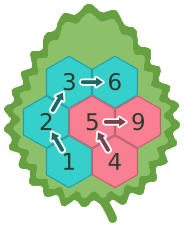
A square board is filled one square at a time, and the rule decides every number: in every row and every column there can be only one 1, two 2s, three 3s, four 4s and so on, and each new square gets the smallest number that keeps it so. The order the squares are filled in paints a picture. The first square is always a 1. In Fill the Screen the line is walked square by square, like a king in chess, and has to fill every square so that the few numbers given come out where they are given. In Find the Line the finished picture is given, and the line that painted it is the answer. Fill from Anywhere and Start Anywhere take away even the first square, and not every 1 in a picture can begin a line. Static ends on whole screens painted by lines chosen at random.
The rules
What it gives you to practise
Counting along a row and down a column at the same time, and checking each count against a rule that never changes. Every square asks the same question: is there a 1 here already, are there two 2s, three 3s? The first time a number appears is the interesting moment, because a square only gets a bigger number once every smaller one is used up in its row or its column. Fill the Screen turns the rule round: for a 3 to come out where one is given, its row or its column must already hold a 1, and its row or its column two 2s, and the line must still leave itself a way through every other square, so the walk is a plan. Find the Line turns it round again, from the picture back to the order that made it.
In a classroom
A good first question is to draw a short line on a blank board and ask what number each square will get before it is written in. The 81 boards run from a picture of eight squares to a screen of forty-three. On most of the boards that give a few numbers, every one of them matters: without it, some other line would do.
 Finding Zero
 Longest Road
 Slug Salad