Eye of Horus
Slices that have to come to exactly one whole, and the question of how many different ways there are.
Play Eye of Horus Share or embed
- Grades
- 3–6
- Subjects
- Fractions, Multiplying & Dividing, Logic
- Kind
- Puzzle
- Original
- Plastic Fraction Circles at MathPickle
What it is
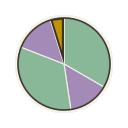
A circle with its smallest slice already in it, say a twelfth, and a tray of slices: a half, a third, a quarter and on down. Fill the circle with slices the same size or bigger, so that they make exactly one whole. One rule: slices side by side may never add up to a single slice, so a third may not sit next to a sixth, because together they make a half. A row of empty circles shows how many ways there are, and the board is done when every one is filled. In Count the Slices the circle has to take an exact number of pieces as well.
The rules
What it gives you to practise
Adding fractions with different denominators, and seeing the common denominator before writing it down: a quarter and a twelfth make a third because 3/12 and 1/12 make 4/12. Every slice has a 1 on top, the Egyptian fractions the puzzle is named for, so every check is whether some neighbours make one of those again. A few facts turn up on their own. A half never goes in, because the rest of the circle would be the other half, all in one run. With sevenths or elevenths as the smallest slice there is only one way: all sevenths, or all elevenths. With sixths there is one too: a third, two quarters and a sixth, with the quarters kept apart.
In a classroom
This is Gordon Hamilton’s Plastic Fraction Circles from MathPickle, which starts from a box of plastic fraction pieces and asks how many ways a circle can be built when the smallest piece is 1/6. The rule about neighbours is his as well, and the number of ways for each smallest slice is entry A394737 in the OEIS: 1, 1, 2, 5, 11 and 1 for sixths, sevenths, eighths, ninths, tenths and elevenths. A real set of fraction circles on the desk is a good companion, and a pair can check each other’s circles by hunting for neighbours that make one piece. Printed, a board is its circle with the smallest slice in it, and the rule in words.
 Fractured Fractions
 Underdog
 Voronoi Islands