Stirring Paint
Deduction with no arithmetic in the way — colours, directions and jumps, worked out until every loop closes.
- Grades
- 2–6
- Subjects
- Logic
- Kind
- Puzzle
- Cost
- Free, no account, no ads
- Original
- Stirring Paint at MathPickle
What it is
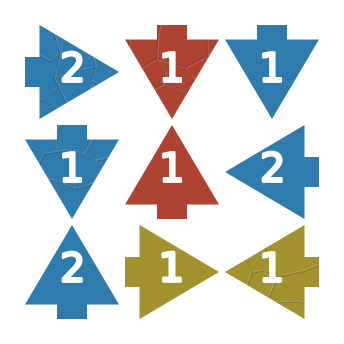
Every cell needs three things: a colour, a direction and a number. The number is how far its arrow jumps, and it has to land on its own colour. When the board is right, each colour’s arrows form a single loop — follow the jumps and you come back where you started.
What it gives you to practise
Deduction with the arithmetic moved out of the way. Nothing on this board has to be calculated; things have to be ruled out. A cell whose jump would land off the edge is decided for you. A colour that has already closed its loop cannot take another arrow. Some boards carry spare paints, which means they are genuinely ambiguous — there is no stored answer to match, only rules that a filled-in board either satisfies or does not.
In a classroom
Gordon Hamilton, MathPickle. It suits a class with a wide spread of arithmetic fluency better than most boards do, because none of the difficulty in it is arithmetic — a child who is behind on tables is not behind here.
The rules
Fill in every cell so all the paint stirs around in loops.
Every cell needs a colour, a direction and a number.
The number is how far it jumps. It must land on its own colour.
Each colour's arrows make one loop. Follow the jumps and you come back where you started.
Near it on the shelf
- Finding the LongestThe longest road in a tree is found by walking away from anywhere twice — a guess by eye, then a count to check it.
- Finding ZeroEvery number turned over says how far zero is, so the hunt closes in by reasoning rather than guessing.
- Hitome's GardenEvery line has just two ways to go, and the walls they make decide which flowers end up sharing a bed.