Slug Salad
Each slug eats a number equal to everything it has eaten before it — addition with a reason to check and go back.
- Grades
- 2–4
- Subjects
- Adding & Subtracting, Counting & Estimating
- Kind
- Puzzle
- Cost
- Free, no account, no ads
- Original
- Slug Salad at MathPickle
What it is
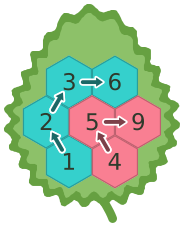
Slugs are eating a leaf, and the puzzle is to work out the path each one crawled. Every step lands on a bigger number than the last. A slug is full when the number it has just landed on equals everything it ate before, added up — and a full slug may go home, or carry on and fill up again. Every hexagon has to be eaten by exactly one slug.
What it gives you to practise
Running totals, held in the head and checked against the leaf. The fullness rule is a doubling rule in a costume: a slug that has eaten 1, 2 and 3 is carrying 6, so 6 fills it. You add forwards to test a path and subtract backwards to see why one cannot work. The board also lets you mark a seam as a wall — your own note that no slug crawled that way — which is how a hunch becomes something you can point at.
In a classroom
Gordon Hamilton, MathPickle. Grades 2–4 on paper, and it stays interesting well above that, because the later leaves carry several slugs whose paths cross and interleave.
The rules
Slugs are eating this leaf. Work out the path each one crawled.
Every step lands on a bigger number.
A slug is full when the number it lands on is all the earlier ones added up. A full slug can go home — or keep crawling, and fill up again.
Drag from one hexagon to a bigger one to draw an arrow. Fill the leaf with arrows and every slug's path is made.
Tap between two hexagons for an arrow, tap again for a wall — your own note that no slug crawls that way — and once more to rub it out.
Near it on the shelf
- Finding ZeroEvery number turned over says how far zero is, so the hunt closes in by reasoning rather than guessing.
- GalaxeaTwo of the three dice are the sides of a rectangle — and the game is which two, and where to hang it.
- Hitome's PaddocksA sheep is worth the squares in its own field, and the two flocks have to end up worth the same.